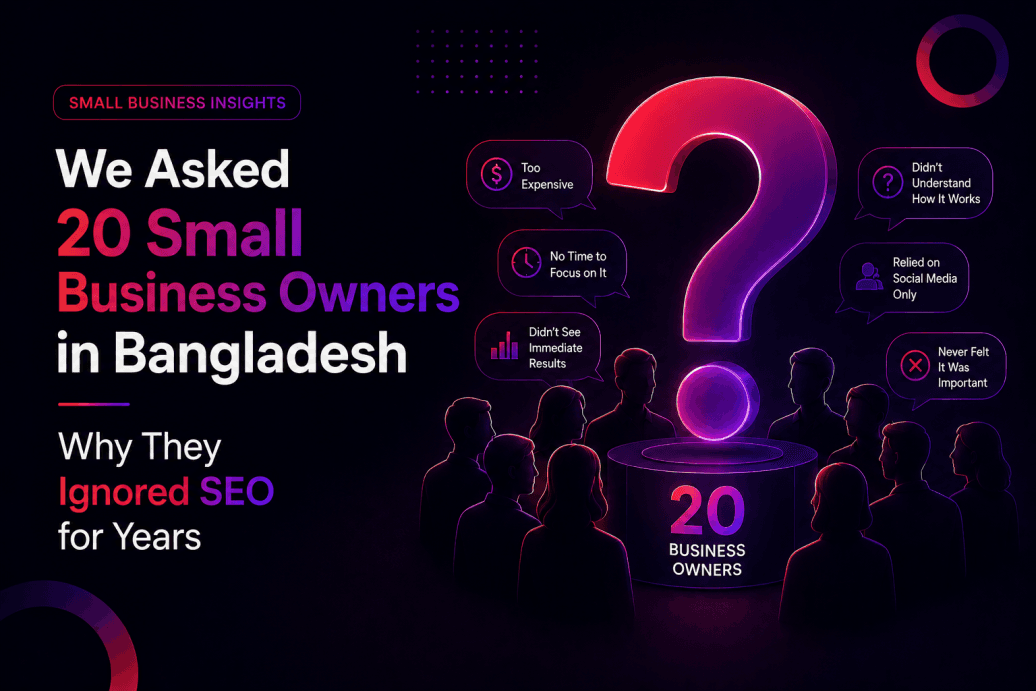
Over several months, our team sat down with more than twenty small business owners across Dhaka, Chattogram and Sylhet, some existing clients, some met at local trade fairs and a few who simply reached out with basic questions about getting found online. We asked all of them a version of the same question: why did SEO never make it onto your marketing budget until now or why hasn’t it yet? The answers were strikingly consistent and none of them had anything to do with business owners being careless or uninterested in growth. They had everything to do with how SEO gets explained, sold and priced in Bangladesh’s small business market.
A quick note before the findings: these were informal, honest conversations rather than a formal statistical survey, so treat the patterns below as recurring themes we heard again and again, not precise percentages. What follows are the reasons that came up most often, roughly in order of how frequently they surfaced.
The Businesses We Spoke With
The owners we interviewed ran a genuine cross-section of Bangladesh’s small business economy: a tailoring shop in Old Dhaka, a fashion boutique in Dhanmondi, a coaching and tutoring center in Chattogram, a real estate agency in Sylhet, a dental clinic, an event management company, an electronics repair shop, a furniture workshop, a boutique hotel outside Dhaka and several F-commerce sellers running their entire operation through a Facebook page. Business ages ranged from under two years to well over a decade. What united them was not industry or size but a shared set of assumptions about what SEO was, none of which turned out to be entirely accurate.
Reason 1: “SEO Sounded Like Something Only Big Companies Need”
This was the single most common response. Several owners described SEO as something they associated with large corporations, banks or international brands with dedicated marketing departments, not a tailoring shop or a tutoring center. One owner of a small furniture workshop put it plainly: SEO felt like a word from a different, bigger world, one with budgets and teams that a family business simply did not have. This perception is not unique to Bangladesh. Research on digital technology adoption among Bangladeshi SMEs consistently finds that a lack of awareness about the actual benefits of digital marketing, not a lack of interest, is one of the primary barriers preventing adoption.
Reason 2: “Facebook Was Already Working, So Why Fix It”
For F-commerce sellers especially, this was less a rejection of SEO and more a simple case of not seeing the need. If a Facebook page is generating orders, even inconsistently, the instinct is to keep doing more of what appears to be working rather than learning something new. Several owners admitted they had never actually tried searching Google for their own type of business to see who showed up first, so they had no real sense of how many potential customers were searching that way instead of scrolling.
Reason 3: Nobody Explained It in Plain, Practical Terms
A recurring complaint was that SEO explanations they had previously encountered were either overly technical or vague marketing language, full of terms like domain authority, crawl budget and backlink profiles, without ever connecting those terms to something as simple as “more customers calling your shop.” Owners repeatedly said they would have taken SEO seriously years earlier if someone had simply shown them, in their own language and industry, what a customer search actually looks like and what it would take to appear in it.
Reason 4: A Bad Past Experience With a Cheap Provider
Roughly a third of the owners we spoke with had tried some form of SEO before, usually through a low-cost freelancer and had been left with either no measurable results or, in a few cases, a website that actually lost visibility afterward. That experience did not just waste their initial budget, it made them permanently skeptical of the entire discipline, treating “SEO” and “wasted money” as functionally the same phrase. This pattern echoes a broader issue we cover in our breakdown of why cheap SEO and affordable SEO are not the same thing, where a single bad experience with a corner-cutting provider often poisons an owner’s willingness to try a legitimate one later.
Reason 5: “My Facebook Page Is My Website”
Several F-commerce sellers had never built a website at all, treating their Facebook page as the complete digital presence for their business. Since SEO is fundamentally about a website appearing in search results, these owners were not so much ignoring SEO as operating in a structure where it did not yet apply to them. This is a well-documented pattern in Bangladesh’s digital economy, where Facebook’s dominance as the default commerce platform has meant that building an independent website often gets treated as optional rather than foundational.
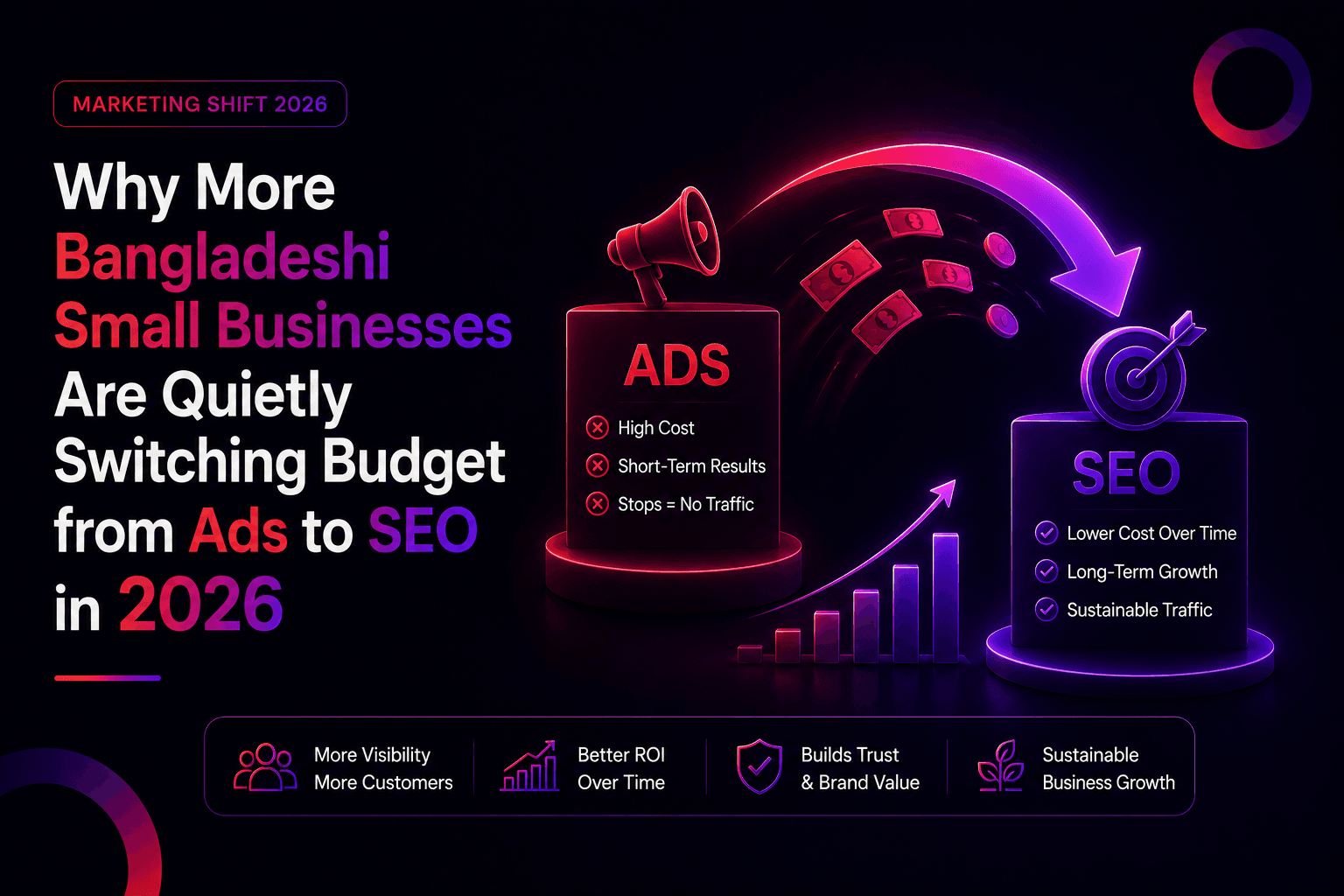
Reason 6: Confusing SEO With Paid Advertising
A handful of owners assumed “SEO” simply meant paying Google for ads, similar to boosting a Facebook post and were confused about why anyone would need an ongoing monthly service for something they thought was a one-time ad purchase. Once the distinction was explained, several said they would have investigated SEO much sooner had someone clarified early on that ranking organically and paying for a Google ad are two completely different mechanisms with very different long-term value.
Reason 7: Expecting Instant Results and Getting Discouraged Before Starting
A few owners who had briefly dabbled in SEO years earlier said they expected to see results within days and when nothing visible happened in the first few weeks, they assumed it did not work and abandoned it. None of them had been told upfront that meaningful movement in rankings typically takes several months, so the timeline mismatch itself became the reason SEO got written off entirely, rather than the strategy being flawed.
Reason 8: Underestimating How Many of Their Own Customers Actually Search on Google
This was one of the more surprising findings. Several owners genuinely believed most of their customers found them through word of mouth or Facebook and had never checked whether people were also searching for their type of business on Google. This is a notable gap given the country’s growth trajectory: Bangladesh’s internet subscriber base has been expanding rapidly and search behavior in local, Bengali-first search queries has been growing right alongside it, even among owners who assumed their specific customer base was not “online” in that way.
Reason 9: Believing Reputation and Word of Mouth Were Enough
For businesses that had operated successfully for a decade or more through referrals and local reputation, SEO simply never felt necessary. Several older, established owners told us their business had survived and grown for years without any digital marketing at all, so investing in it now felt like solving a problem they did not believe they had. What most of these owners had not yet accounted for is that word of mouth increasingly starts with someone searching a business name on Google to verify it before ever calling or visiting, meaning weak search visibility can quietly undermine referral business too.
Reason 10: Assuming It Would Always Be Too Expensive
Several owners assumed SEO pricing started somewhere near what large corporate agencies charge and never got far enough into research to discover that scaled-down, genuinely affordable packages exist for businesses their size. This assumption alone kept multiple owners from even requesting a quote for years.
What This Reflects About Bangladesh’s Broader SME Landscape
These anecdotal patterns line up closely with formal research on the topic. Academic studies on digital technology adoption among Bangladeshi SMEs consistently identify the same three core barriers: financial constraints, a shortage of digital skills and expertise and limited awareness of what digital tools like SEO actually deliver, particularly outside major urban centers. With Bangladesh now home to roughly 11.8 million economic units, the overwhelming majority of them small or micro enterprises, this awareness gap represents a genuinely large, underserved market rather than a niche problem affecting a handful of businesses.
What Finally Changed Their Minds
Almost every owner who eventually did invest in SEO described the same trigger: watching a direct competitor start appearing above them in search results, often after losing a specific, identifiable customer who mentioned finding a competitor “on Google” instead. That single, concrete moment consistently did more to shift an owner’s thinking than any amount of general marketing advice ever had. A few others pointed to the pandemic years, when in-person foot traffic dropped sharply and searching online became the only way many customers could find a business at all, as the moment they realized their competitors with a search presence were simply surviving better.
What This Means If You Have Been Avoiding SEO Too
If any of these reasons sound familiar, the good news is that none of them describe a permanent situation. SEO is not exclusive to large corporations, it does not require abandoning Facebook and it does not have to start at a price point built for a national brand. It also is not an instant fix, which is exactly why starting earlier rather than later matters so much, since the businesses that begin building search visibility now are the ones that will not be scrambling to catch up when a competitor eventually starts showing up first.
If you want to understand what a properly scoped, honest engagement looks like before committing any budget, our earlier guide on why cheap SEO and affordable SEO are not the same thing walks through what separates a corner-cutting provider from one that will genuinely help. And if a past bad experience is part of why you have been hesitant, it is worth reading our breakdown of why guaranteed ranking offers are a red flag so you know exactly what to avoid the second time around.
At SEOMINDZ, we built our approach specifically around the patterns we heard in these conversations: plain-language explanations, realistic timelines and pricing scaled for the businesses that make up most of Bangladesh’s economy. If you have been putting off SEO for any of the reasons above, our affordable SEO services for small business in Bangladesh are built to meet you at exactly the point you are starting from, whether that is a first website or a Facebook page ready to become something more and our local SEO service in Bangladesh is designed specifically for owners who want to be found by nearby customers first. You can reach our team directly through our contact page to talk through where your business currently stands.
FAQ
Is it too late for my small business to start SEO if I have ignored it for years?
No, it is not too late. Search rankings are earned continuously, not awarded once and locked in, which means a business starting today has the same fundamental opportunity to build visibility as one that started years ago, just with a later starting point relative to competitors already investing. The businesses that lose the most ground are the ones that keep delaying rather than the ones that started late.
My customers mostly find me through Facebook. Do I really need SEO too?
Most likely yes, because many customers who first discover a business through Facebook still search for it on Google afterward to confirm it is legitimate before calling or visiting. A weak or nonexistent search presence at that verification step can quietly cost you customers who were already interested through social media, even if Facebook remains your primary discovery channel.
How do I know if an SEO provider will explain things in a way I can actually understand?
Ask them to explain, in plain terms and using your own business as the example, exactly what a customer search for your type of business looks like today and what specifically would need to change for you to appear in it. A provider who cannot answer that clearly and specifically, without falling back on jargon, is unlikely to communicate well throughout the actual engagement either.
What is a realistic first step if I have a Facebook page but no website?
Building a simple, functional website is the necessary first step, since SEO fundamentally optimizes a website’s presence in search results rather than a social media page. This does not need to be an elaborate or expensive site initially, just a foundation that can be optimized and expanded as your search visibility grows.
How long did it take the business owners you spoke with to see results after finally starting SEO?
Most who followed through described noticeable movement in search visibility within three to six months, consistent with realistic industry timelines, with continued growth beyond that as their websites built more authority. None described meaningful results appearing within the first few weeks, which matches what any legitimate SEO provider should tell you upfront.