Ask most small business owners in Bangladesh how much they spent on marketing last month and they can usually answer within a few thousand taka. Ask them how much that spending actually cost per new customer and most go quiet. Not because the number is hidden, but because almost nobody sits down and calculates it. This piece walks through exactly how to find that number for your own business and how to honestly compare it against what SEO would likely cost per customer instead.
The Question Every Owner Skips: What Is Your Real Cost Per Customer
The metric you are looking for is called customer acquisition cost or CAC. The standard formula, used across corporate finance and marketing analytics alike, is simple: total marketing spend for a given period divided by the number of new customers acquired in that same period. If you spent 30,000 BDT on marketing in a month and it produced 60 new customers, your CAC for that month was 500 BDT per customer.
That single number changes how every marketing decision looks. A campaign that “feels expensive” at 40,000 BDT a month might actually have a lower CAC than a “cheap” 8,000 BDT campaign, if the cheap one is only bringing in three or four customers a month. Owners rarely compare channels this way because boosted post costs and SEO retainers are billed so differently that they never end up on the same spreadsheet. They should.
Calculate Your Current CAC in Three Steps
- Pick a reporting period. One month is usually enough for fast-moving channels like Facebook boosting; three to six months gives a more honest picture for anything with a longer sales cycle, including SEO.
- Add up everything you actually spent. Include ad spend or SEO retainer fees, plus any agency or freelancer management cost, since the true cost of a channel includes the labor to run it, not just the raw ad budget.
- Count new customers directly traceable to that channel. This is the step most owners skip. If you cannot currently trace this, start asking every new customer a simple “how did you find us” question, even informally, for the next month.
Divide step two by step three and you have your CAC for that channel. Do this separately for every channel you currently use and the comparison usually reveals something owners did not expect.
What Bangladeshi Businesses Are Actually Paying Per Customer on Facebook Boosting
Current Bangladesh-specific benchmarks put average Facebook ad costs at roughly 15 to 60 BDT CPM and 3 to 25 BDT per click, with cost per lead typically running 50 to 300 BDT depending on industry and creative quality. Not every lead becomes a paying customer. If your typical lead-to-customer conversion rate sits around 20 to 30 percent, a reasonable middle-ground assumption for many small retail and service businesses, a 150 BDT lead translates to a CAC somewhere between 500 and 750 BDT once you account for leads that never convert.
It is also worth factoring in a trend several Bangladeshi ad specialists have flagged directly: advertiser competition on Meta’s platform has grown roughly fivefold since 2022, pushing average CPMs meaningfully higher than they were just a few years ago. That means your CAC on Facebook boosting this year is very likely higher than it was last year for the same budget and targeting, even if nothing about your campaign changed.
What They’re Paying Per Customer on Google Ads
Google Ads in Bangladesh currently runs roughly 10 to 80 BDT per click depending on industry competitiveness, generally higher than Facebook’s CPC because Google traffic reflects active buying intent rather than passive scrolling. That higher per-click cost is often offset by a stronger conversion rate, since someone who searched for your exact product or service is closer to a purchase decision. Even so, the moment your daily budget runs out, this channel’s contribution to your CAC calculation for that period stops entirely, the same limitation boosting carries.
What SEO Actually Costs Per Customer, Once You Include the Full Picture
This is where the comparison gets genuinely interesting, because SEO’s CAC is not a fixed number, it is a curve. A realistic small business SEO engagement in Bangladesh runs roughly 20,000 to 40,000 BDT per month. In the first two or three months, almost none of that spend has produced a customer yet, since technical fixes, content and early rankings are still being built. Calculated naively during that window, SEO’s CAC looks terrible, arguably infinite.
By month six, if the engagement is being run properly, that same monthly fee is now supporting a growing base of ranking keywords and organic traffic that did not exist before, at no additional per-click or per-lead cost. By month twelve, many businesses are seeing a meaningful share of their new customers arrive through organic search, still against that same flat 20,000 to 40,000 BDT monthly cost. This is precisely why global benchmark research places organic search’s average cost per lead at roughly 31 US dollars, compared with figures closer to 150 to 180 US dollars for paid channels once total spend is accounted for. The absolute BDT figures will differ locally, but the underlying pattern, a fixed monthly SEO cost producing a growing and eventually much larger number of customers, holds directly for the Bangladeshi market too.
CAC That Rises vs CAC That Falls
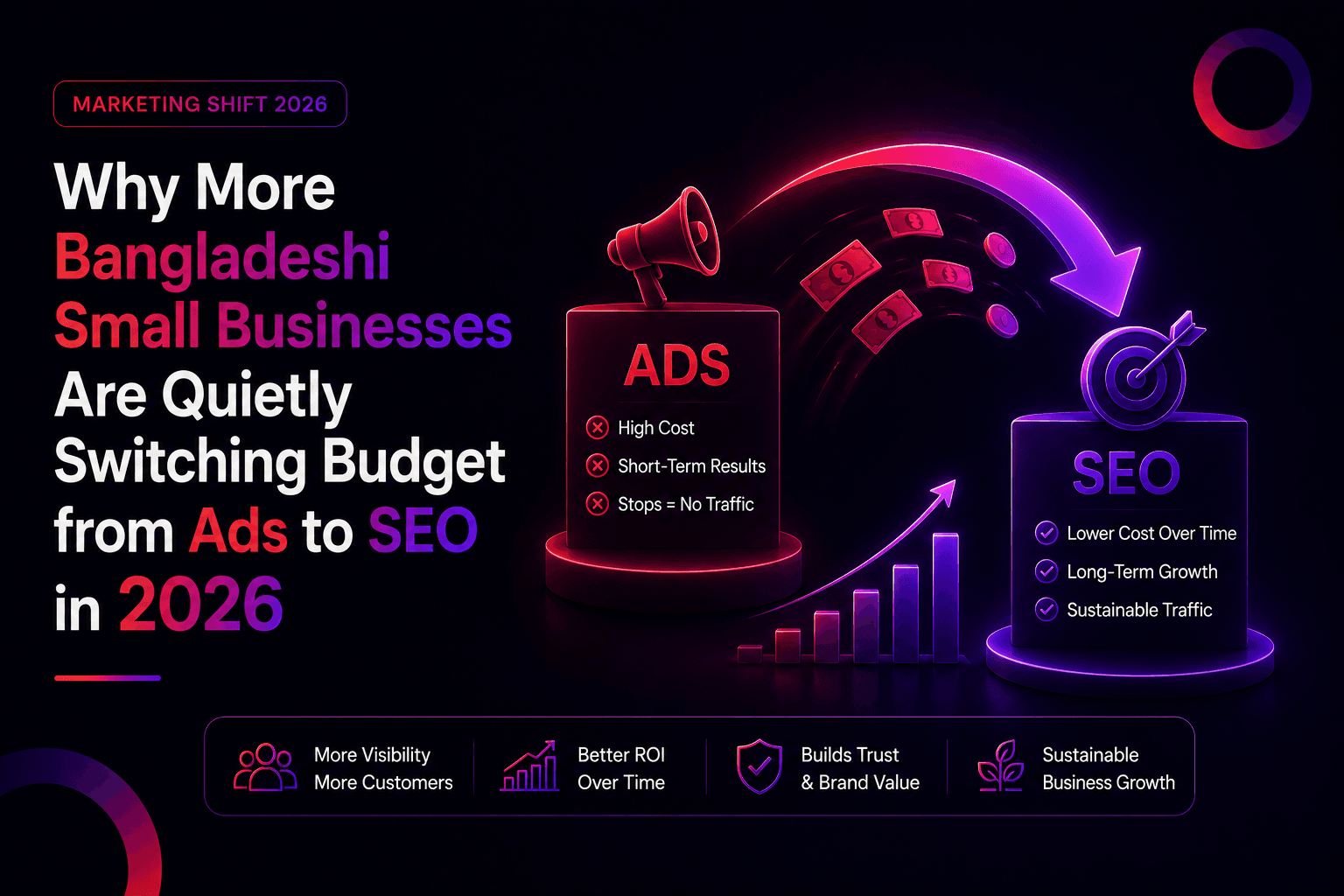
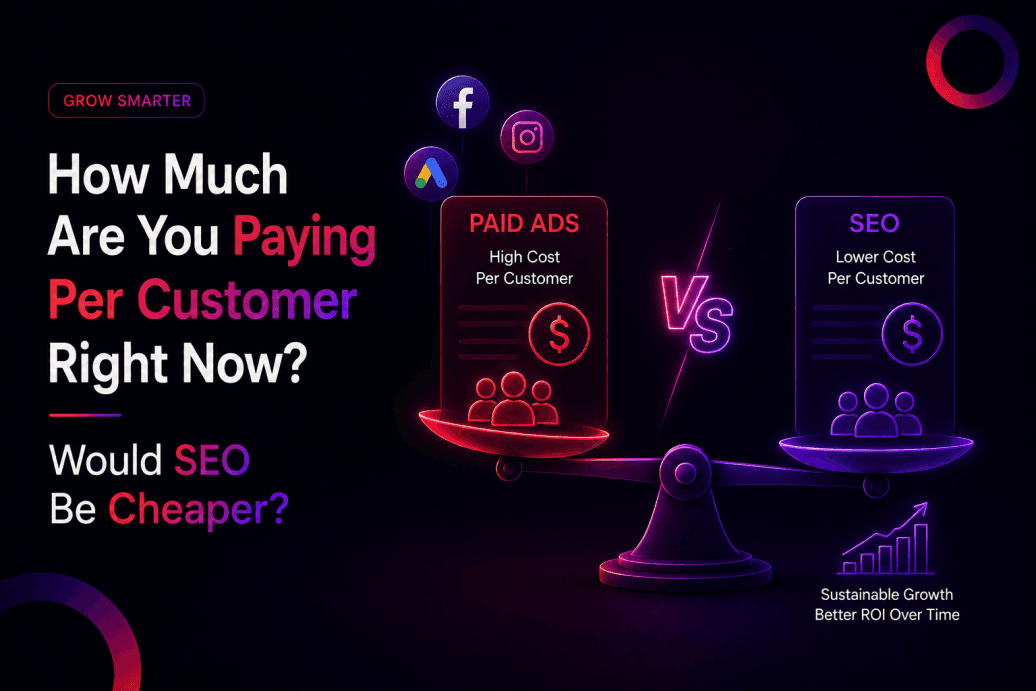
This is the core insight a CFO-minded owner should take away from this comparison. Paid channels like Facebook boosting and Google Ads have a CAC that stays roughly flat or even climbs as competition for your audience increases, because every single customer requires fresh spend to acquire. SEO has the opposite shape: cost per customer starts high while the foundation is being built, then falls steadily as rankings mature and organic traffic compounds without requiring proportionally more spend.
Picture two lines on a graph. The paid channel’s line runs mostly flat, maybe drifting upward slightly over a year as ad auctions grow more competitive. The SEO line starts high, crosses below the paid line somewhere around month six to nine for most small businesses and keeps declining after that, sometimes for years, as long as the content and rankings are maintained. The month that crossover happens is effectively the month SEO becomes the cheaper channel per customer and for most consistently invested small businesses, that month arrives well within the first year.
A Side-by-Side Twelve-Month Example
Consider two businesses in Dhaka, each spending roughly 25,000 BDT per month on marketing.
Business A, Facebook boosting only: Spends 25,000 BDT every month for twelve months, a total of 300,000 BDT. Assuming a fairly typical 500 to 750 BDT CAC throughout the year, this produces somewhere between 400 and 600 new customers over the year, with the CAC staying roughly consistent or worsening slightly, month over month.
Business B, SEO investment: Spends the same 25,000 BDT every month, also totaling 300,000 BDT over the year. Months one through three produce almost no directly attributable customers as the foundation is built. Months four through eight see steadily increasing organic traffic and a growing number of customers each month. By months nine through twelve, monthly organic customer counts are meaningfully higher than they were in month five, at the same flat monthly cost and that traffic continues generating customers into the following year even if the SEO budget were paused.
Neither example is a guarantee, since results depend heavily on industry, competition and execution quality, but the shape of the two curves is consistent and well documented across the SEO industry and it is exactly why comparing channels on a single month’s CAC alone gives a misleading picture.
When Paid Channels Still Win on CAC
An honest comparison has to acknowledge where paid advertising genuinely produces a lower CAC, at least in the short term. Time-bound promotions, such as an Eid collection launch, a flash sale or a one-time event, need immediate reach that SEO cannot deliver on that timeline, regardless of budget. A brand-new business with zero existing audience or reputation may also see faster initial traction from paid channels while an SEO foundation is still being built in the background. This is a pattern we covered in more depth in our comparison of SEO versus Facebook boosting for Bangladeshi businesses, where sequencing both channels correctly, rather than choosing only one, produced the best outcome for most small businesses.
How to Calculate Your Break-Even Point Between Paid and SEO
Take your current paid CAC and divide your monthly SEO investment by it. If your Facebook boosting CAC is 600 BDT and you are considering a 30,000 BDT monthly SEO package, that package needs to produce roughly 50 customers a month to match your current paid CAC. In the early months, SEO will not hit that number, which is expected. What matters is tracking whether that monthly customer count is trending upward month over month. If it is, you are moving toward the point where SEO’s CAC drops below your paid CAC and after that point, every additional customer effectively gets cheaper rather than staying flat.
The CFO Questions to Ask Before Your Next Marketing Budget Cycle
- What is my actual CAC by channel this month, not just my total spend?
- Is that CAC trending up, flat or down compared to three months ago?
- What percentage of my customers are repeat buyers and does that change how much I can afford to spend acquiring a first-time customer?
- If I stopped paying for my current channel today, would my customer flow stop immediately or would it continue for months afterward?
- Am I judging any single channel’s cost within the same month I started it, when its true cost per customer may only become clear several months later?
That last question is the one most Bangladeshi small businesses get wrong specifically about SEO, judging it against a thirty or sixty day paid-media timeline rather than the several-month curve it actually follows.
Where This Leaves Your Marketing Budget
If your Facebook boosting CAC has been quietly climbing while your customer base has stayed flat, that is a legitimate signal to test whether a portion of that budget would perform better redirected toward search visibility that keeps compounding rather than resetting every month. This does not mean abandoning paid channels, which still have a clear role for time-sensitive campaigns, but it does mean giving SEO a fair, full comparison rather than a same-month one.
At SEOMINDZ, we help Bangladeshi small businesses build exactly this kind of channel comparison before recommending where their next taka should go. Our affordable SEO services for small business in Bangladesh are scoped around realistic monthly budgets and honest timelines and our local SEO service in Bangladesh is built specifically to lower your CAC for the nearby customers who matter most. If you want help calculating your actual CAC across channels before committing next month’s budget, reach out through our contact page and we will walk through the numbers with you directly.
FAQ
What is a good customer acquisition cost for a small business in Bangladesh?
There is no universal good number, since it depends entirely on your average sale value and profit margin, but a widely used benchmark is keeping CAC at roughly one-third or less of a customer’s total lifetime value to your business. A business with a low average order value needs a much lower CAC to stay profitable than one with high-value, repeat customers.
How do I calculate CAC if I cannot tell which channel brought in a customer?
Start simply by asking new customers directly how they found your business, even through an informal question at checkout or during a phone inquiry and log the answers for a full month. This will not be perfectly precise, but it gives you a directional breakdown across channels that is far more useful than having no data at all.
Is SEO’s cost per customer really lower than Facebook boosting in Bangladesh specifically?
The general pattern, a flat or rising CAC for paid channels versus a declining CAC for SEO over time, holds consistently across markets, though exact BDT figures will vary by industry and competition level in Bangladesh. The only way to know your specific numbers is to track both channels’ CAC over a full six to twelve month period rather than assuming either channel automatically wins.
Should I stop Facebook boosting entirely once my SEO CAC drops below it?
Not necessarily, since paid channels still offer speed and precision that SEO cannot replicate for time-sensitive campaigns like product launches or seasonal sales. Many businesses keep a smaller, targeted paid budget for those specific moments while relying on SEO as the lower-cost, steady backbone of ongoing customer acquisition.
How soon should I expect my SEO customer acquisition cost to become competitive with paid ads?
Most small businesses in Bangladesh see SEO’s CAC begin approaching or beating their paid channel CAC somewhere between six and nine months into a consistent, properly executed campaign. This timeline can shift earlier for low-competition local keywords or later for highly competitive national terms, so tracking your own monthly customer count trend is more reliable than relying on a fixed timeline.