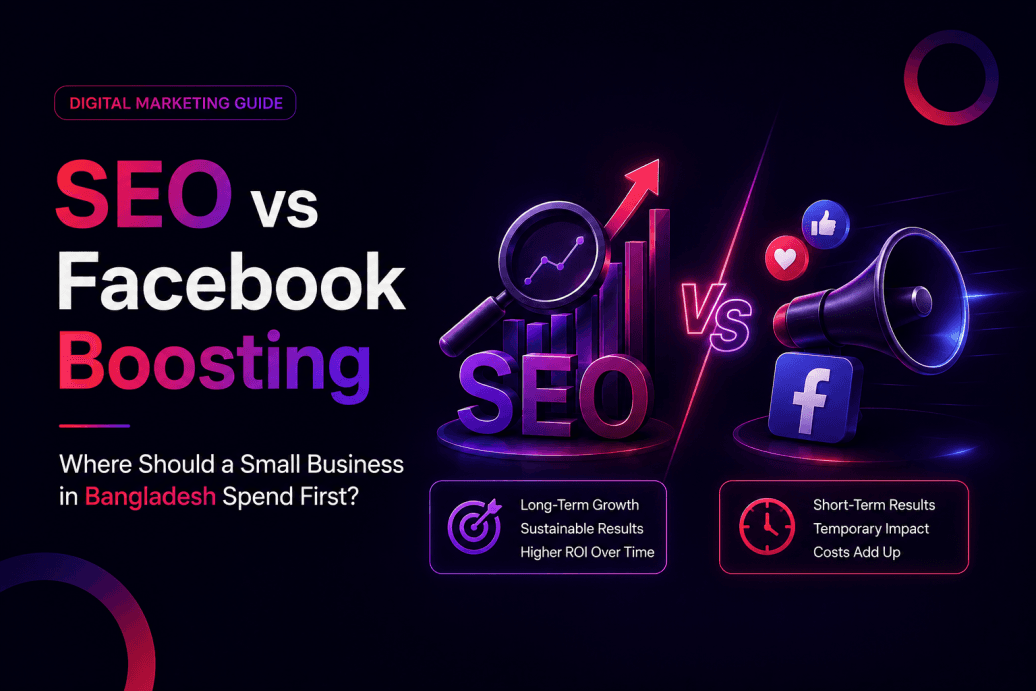
Almost every small business owner in Bangladesh has faced this exact moment: a limited monthly marketing budget, a phone full of “boost your post” notifications and a nagging feeling that SEO is something bigger companies do. So the blue button gets clicked, a few thousand taka gets spent, some likes and comments show up and the cycle repeats the next month. This guide breaks down what boosting actually delivers versus what SEO delivers, using current data, so you can decide where your first marketing taka should actually go.
Why Bangladeshi SMEs Default to Facebook Boosting First
The default is not accidental. Bangladesh has roughly 74.8 million monthly Facebook users as of mid-2026, accounting for over 41 percent of the country’s total population using the platform. On top of that, the country’s F-commerce ecosystem is enormous: industry estimates put the figure at over 300,000 active sellers using Facebook pages as their primary storefront, alongside more than 50,000 dedicated e-commerce websites. Combined, Bangladesh’s e-commerce market crossed roughly 3 billion US dollars in annual transaction volume in 2025 and is projected to approach 4 billion dollars by the end of 2026.
Boosting is also simply easier to start. You can boost a post for as little as 500 BDT per day, pay through bKash or a local card and see likes and reach numbers within minutes. There is no waiting, no technical setup and no need to understand search behavior. For a business owner juggling inventory, staff and daily operations, that immediacy is the whole appeal. The problem is that immediacy and effectiveness are two different things and conflating them is where a lot of marketing budget in Bangladesh quietly disappears.
How Facebook Boosting Actually Works and Its Real Limits
When you tap “Boost Post ” Facebook is not giving your existing audience a bigger platform for free. It is running a simplified version of an ad auction and you are bidding against every other advertiser targeting a similar audience at that moment. In Bangladesh, boosted campaigns typically run in the range of 15 to 60 BDT CPM (cost per thousand impressions) and 3 to 10 BDT CPC (cost per click), though costs climb sharply during Eid ul-Fitr, Eid ul-Adha and other peak retail seasons when advertiser competition spikes 2 to 3 times over.
The bigger limitation is what happens the moment you stop paying. Facebook Page organic reach, meaning how many of your existing followers see a post without a boost, has collapsed industry-wide. Current benchmarks put average organic reach for business pages at around 2.2 percent of total followers, down from over 15 percent in 2014. In practical terms, a page with 10,000 followers in Dhaka might see only 200 to 500 people view an unpaid post. This is not a temporary glitch. It reflects Meta’s deliberate business model: the platform monetizes the news feed by limiting free distribution, which pushes businesses toward continuous ad spend just to stay visible to people who already chose to follow them.
Boosting also has a structural targeting weakness compared to full Ads Manager campaigns. A boosted post optimizes mainly for engagement (likes, comments, shares) rather than business outcomes like leads or purchases and it offers far less control over audience exclusions, placements and bidding strategy. Many Bangladeshi agencies now recommend moving budget from simple boosting into properly structured Meta Ads Manager campaigns specifically because boosting alone tends to reward vanity engagement over revenue.
How SEO Works Differently: Capturing Buying Intent
Search engine optimization does not interrupt someone scrolling through photos of friends and family. It meets someone at the exact moment they type a need into Google, such as “wedding photographer in Dhaka” or “best AC service near me.” That distinction, intent versus interruption, is the core reason the two channels behave so differently in terms of return on investment.
Organic search currently drives an estimated 53.3 percent of all website traffic globally, compared to roughly 5 percent from all social platforms combined, despite social media receiving a disproportionate share of marketing attention and budget. Benchmark research also shows a stark cost-per-lead gap: organic SEO channels average around 31 US dollars per lead, while paid social and search advertising often runs closer to 150 to 180 US dollars per lead once management fees and ad spend are combined. SEO leads also tend to close at a notably higher rate. One widely cited benchmark places SEO-driven lead close rates at 14.6 percent, compared with roughly 1.7 percent for outbound and interruption-based marketing.
The mechanism behind this is compounding. A blog post or service page you publish today might rank on page two initially, move up gradually over three to six months as Google builds trust in your site and then continue earning free traffic for years afterward with no additional spend required for that piece of content. A boosted post, by contrast, stops generating any reach the moment your daily budget runs out. This is why long-term SEO investment is frequently cited as delivering some of the highest returns of any digital channel, sometimes quoted around a 22 to 1 return once compounding is factored in over multiple years.
Cost Comparison: Boosting vs SEO Over a Full Year
To make this concrete for a Bangladeshi small business, consider two owners each spending roughly 15,000 to 20,000 BDT per month.
Owner A (Facebook boosting only): Spends the full budget on boosted posts every month. Traffic and inquiries rise during active campaigns and drop close to zero within days of pausing spend. After 12 months, roughly 180,000 to 240,000 BDT has been spent and the business has no owned digital asset beyond a Facebook page with fluctuating reach. If the ad account gets restricted or Meta changes its algorithm, visibility can disappear overnight.
Owner B (SEO investment): Spends a similar monthly amount on technical SEO audit and fixes, content creation and an ethical off page SEO and link building strategy. Growth is slower in months one through three, often frustratingly so, but by month six the website is ranking for several buyer-intent keywords and by month twelve organic traffic is arriving daily without any additional per-click cost. That traffic and the rankings behind it, remain in place even during months with no new spend, functioning as a business asset rather than a recurring expense.
Neither path is free and neither is automatically “better” in isolation. The difference is what each taka buys: rented visibility that vanishes when spending stops or owned visibility that keeps compounding.
Search Intent vs Social Interruption: The Real Difference
It helps to think of these two channels in terms of what the user is doing at the moment they encounter your business.
- Facebook boosting reaches people mid-scroll. They are looking at photos from a cousin’s wedding or a cricket highlight reel, not actively shopping. Your ad has to stop that behavior and create a want that did not previously exist. This works exceptionally well for visually striking, impulse-friendly products such as fashion, food delivery and beauty items, which is exactly why F-commerce dominates those categories in Bangladesh.
- SEO reaches people who already have a need. Someone searching “emergency plumber Dhaka” or “corporate lawyer Chattogram” has already decided they need a solution and is actively comparing providers. Google Search alone processes several billion queries daily worldwide and Bangladesh-specific search volume has been growing at roughly 25 percent year over year as internet penetration expands. That searcher is closer to a purchase decision than almost anyone you could interrupt on social media.
Neither form of intent is inherently superior. A business selling trendy clothing to an 18 to 24 year old audience, the largest single Facebook demographic in Bangladesh, may genuinely see faster short-term returns from boosting. A business selling considered, high-ticket or professional services, where customers research before buying, will almost always see stronger long-term returns from search visibility.
Which Channel Fits Which Type of Bangladeshi Business
Lean toward Facebook boosting first if you are:
- Selling visually driven, low-consideration products (clothing, accessories, home décor, food)
- Running short, time-bound promotions (Eid collections, flash sales, event-based offers)
- Building initial brand awareness for a completely new page with no existing audience
- Testing a new product concept before committing to a long-term content strategy
Lean toward SEO first if you are:
- A service-based business where customers actively search before buying (clinics, law firms, real estate agents, educational institutes, repair services, contractors)
- Operating in a niche where trust and credibility matter more than impulse (financial services, healthcare, B2B suppliers)
- Trying to reduce long-term dependence on rising ad costs
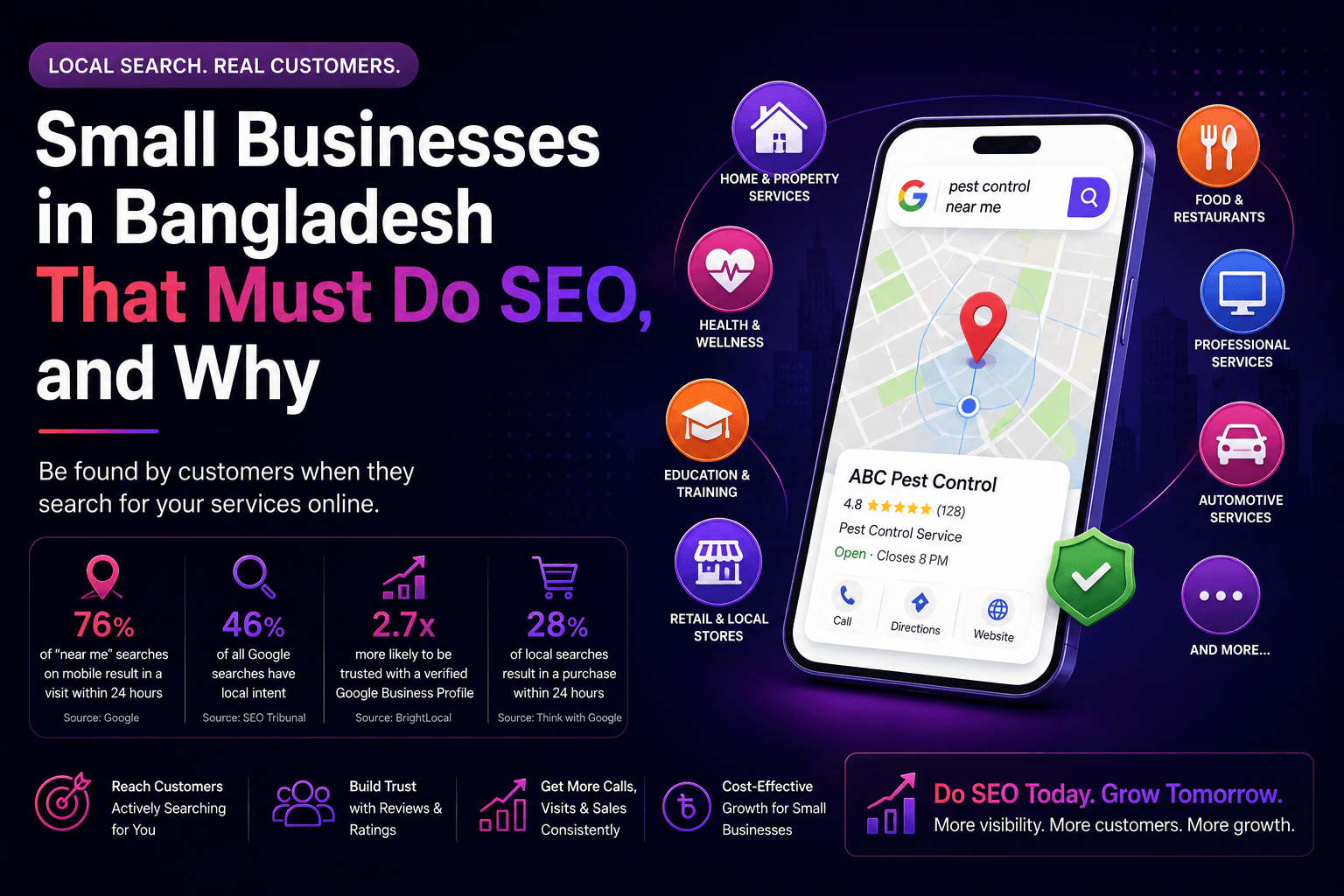
- Serving a specific neighborhood or city and want to appear in local map results, which benefits from a dedicated local SEO service in Bangladesh strategy alongside general search optimization
Most established businesses eventually need both, but the order in which you invest your first taka should follow how your specific customers actually shop.
Why “Just Do Both” Is Correct, But the Sequencing Still Matters
Combining both channels is genuinely the ideal long-term strategy for almost every Bangladeshi SME, but sequencing your budget correctly makes a measurable difference to cash flow and results. A common and effective pattern looks like this:
- Months 1 to 3: Use Facebook boosting for quick market validation, immediate cash flow and audience building while your SEO foundation, including technical fixes and initial content, is being built in the background. SEO rarely produces meaningful traffic this early regardless of how well it is executed, so relying on it exclusively during this window can starve a new business of near-term revenue.
- Months 3 to 6: Begin shifting a portion of ad budget toward sustained SEO investment as early rankings for long-tail, lower-competition keywords start to appear. Continue boosting for promotions and time-sensitive campaigns, but stop treating it as your only channel.
- Months 6 to 12 and beyond: SEO traffic should be growing steadily and requiring less incremental spend per visitor than boosting does. At this stage, many businesses reduce boosting to promotional bursts around specific campaigns while organic search becomes the steady, lower-cost backbone of lead generation.
This sequencing avoids the two most common mistakes: businesses that pour everything into boosting and never build a lasting asset and businesses that invest everything into SEO on day one and run out of cash before rankings mature enough to produce revenue.
Common Mistakes Bangladeshi Small Businesses Make
- Treating boosting as a growth strategy rather than a visibility tap. Once the budget stops, the visibility stops with it and nothing compounds for next month.
- Judging SEO’s success within the first 60 days. Legitimate SEO typically needs several months before meaningful ranking movement appears; expecting boosting-speed results from SEO leads many owners to abandon it just before it starts working.
- Boosting posts with no clear objective. Boosting for “likes” rarely converts to sales. Campaigns built around a specific action (message us, visit website, call now) consistently outperform generic engagement boosts.
- Ignoring the website entirely. Many F-commerce sellers operate purely through a Facebook page with no website at all, which means there is no SEO asset to build in the first place and no way to capture the growing share of Bangladeshi consumers who research a business on Google before messaging a Facebook page.
- Assuming SEO and social media compete for the same customer. In reality they usually capture people at different stages of the buying journey and a customer often encounters a brand on Facebook first, then searches for it on Google to verify legitimacy before purchasing, which means weak search visibility can quietly undermine your Facebook results too.
A Simple Framework to Decide Your First-Dollar Priority
Ask these four questions before allocating next month’s budget:
- Does my customer typically search for what I sell or do they discover it by accident while scrolling? Searched-for products and services lean SEO; impulse and visually driven products lean boosting.
- How urgently do I need revenue this month versus building an asset for next year? Immediate cash flow pressure favors boosting; long-term stability favors SEO.
- Is my price point high enough that customers research before buying? Higher consideration purchases (education, legal, medical, real estate, B2B) benefit disproportionately from search visibility and trust signals.
- Do I already have a functioning website or only a Facebook page? If there is no website, that is itself the first investment to make, since it is the foundation SEO is built on and something rented ad platforms cannot replace.
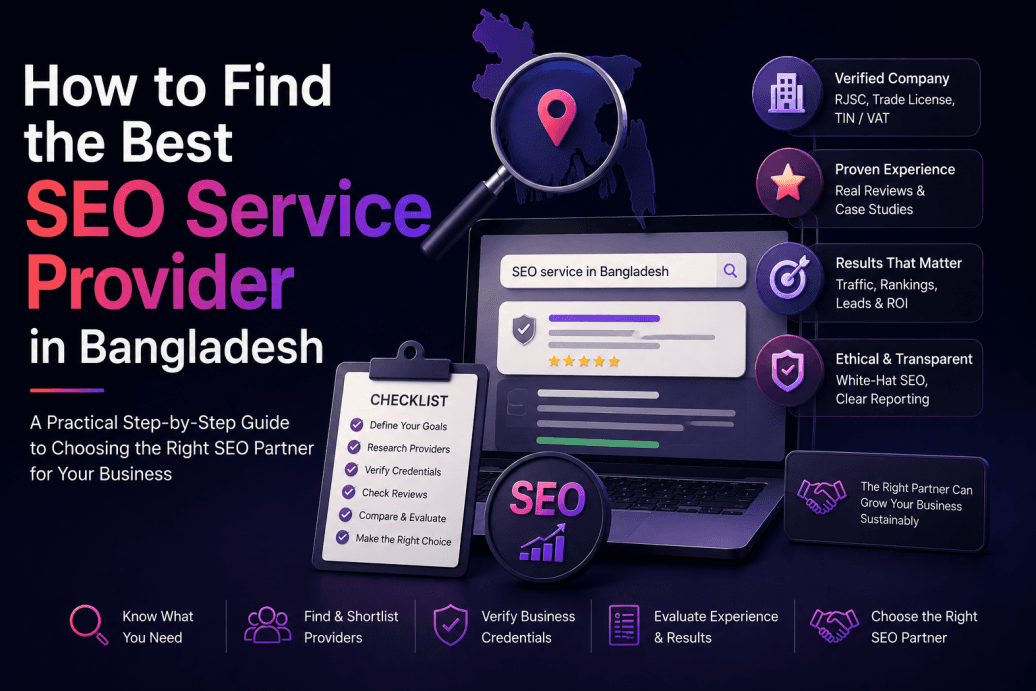
If you are still unsure which channel deserves your next budget cycle, it is worth reading our related guide on why guaranteed ranking offers are a red flag before hiring anyone to manage either channel, since the same due diligence applies to paid social agencies as it does to SEO vendors. For a broader look at your options, our comparison of choosing between an SEO agency and an in-house team walks through the trade-offs in more depth.
At SEOMINDZ, we work with Bangladeshi small businesses to build affordable SEO services for small businesses in Bangladesh that complement, rather than compete with, whatever social media spend you already have. If you want a clear-eyed assessment of where your specific business should invest first, you can reach our team through our contact page for a straightforward consultation.
FAQ
Should a brand new small business in Bangladesh start with SEO or Facebook boosting?
Most brand new businesses benefit from starting with light Facebook boosting to generate initial cash flow and validate demand, while simultaneously building the technical and content foundation for SEO in the background. Relying on SEO alone in the first few months usually leaves a new business without revenue during the ranking build-up period, since meaningful movement typically takes three to six months.
Is Facebook boosting a waste of money for a service business like a clinic or law firm?
Not entirely, but it is rarely the most efficient channel for service businesses where customers actively research and compare before making a decision. These businesses usually see stronger returns from search visibility, since a person searching “dental clinic near me” is closer to booking an appointment than someone who saw a boosted post while scrolling.
How much should a small business in Bangladesh budget for SEO versus Facebook ads?
There is no fixed ratio, since it depends on the business type and urgency of revenue needs, but many Bangladeshi small businesses start with a roughly even split, adjusting over the first six months toward whichever channel shows a lower cost per lead for their specific industry. Local digital marketing agency rates in Bangladesh typically range from 500 to 3,000 US dollars per month depending on scope.
Does ranking well on Google actually matter if most of my customers find me through Facebook?
Yes, because many customers who first discover a business on Facebook still search for it on Google afterward to check reviews, verify legitimacy or compare prices before messaging or purchasing. A weak or nonexistent search presence at that verification stage can quietly cost you customers who were already interested through social media.
Can I stop Facebook boosting once my SEO starts working?
Many mature businesses reduce boosting to specific campaigns, such as new product launches or seasonal promotions, once organic search becomes a steady source of leads, rather than stopping it entirely. Facebook still offers speed and precise targeting that SEO cannot replicate for time-sensitive offers, so the two channels typically continue working best together rather than one fully replacing the other.